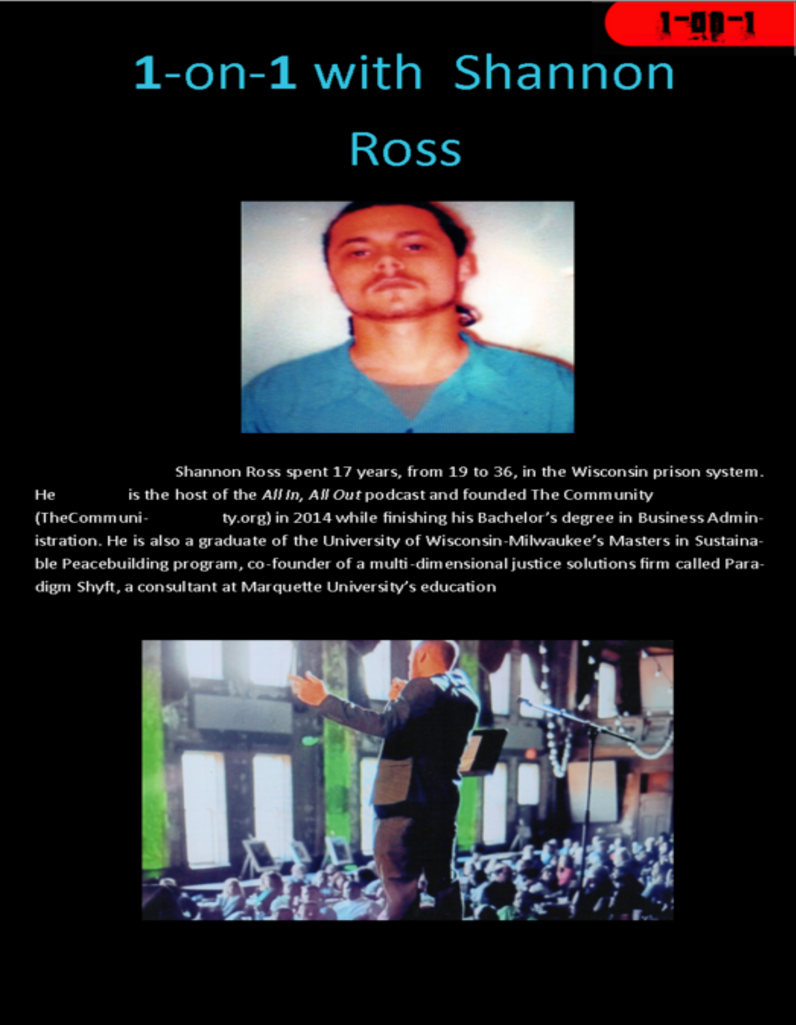
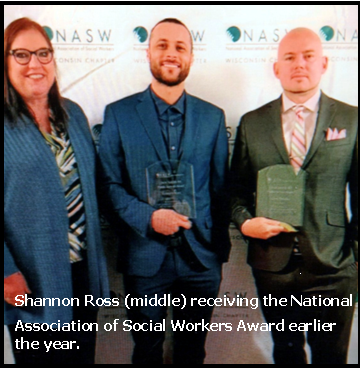
Shannon Ross spent 17 years, from 19 to 36, in the Wisconsin prison system. He is the host of the All In, All Out podcast and founded The Community (TheCommunity.org) in 2014 while finishing his Bachelor’s degree in Business Administration. He is also a graduate of the University of Wisconsin-Milwaukee’s Masters in Sustainable Peacebuilding program, co-founder of a multi-dimensional justice solutions firm called Paradigm Shyft, a consultant at Marquette University’s education preparedness program, has graduated several national fellowships, and is the proud father of a 3-year-old boy. We got to ask the man a few questions to get some insight…
23&1 – Shannon, will you please tell us where you are from, and a little bit about your background?
S.R. – I grew up in inner city Milwaukee, Wisconsin. I was the only child of a lower middle-class mixed couple (White mom, Black dad). I was a short, shy, pretty boy with White people hair, and more interest in soccer than basketball. Not surprisingly, I was an easy target for the jokes and macho contempt of my predominantly Black friends and peers. I was also a clown, dangerously independent-minded, and had a very loving family. As a result, the teasing and minor bullying didn’t crush my self-esteem.
23&1 – So why were you incarcerated? You spent 17 years in, right?
S.R. – My charge was 1st Degree Intentional Homicide, and yes, I was locked up for 17. A minor drug deal turned robbery became an act of fatal revenge. I was vengeful, responding to disrespect and provocation outside the heat of the moment. Honor and justice have always been extremely important to me, and back then this translated into loyalty to the street code, which demanded not getting punked. I was all to eager to enforce it in a methodical, over-the-top, righteous kill, but in reality, I was just another puppet in ego’s workshop.
23&1 – Another puppet in ego’s workshop! I like that. The same was true for me.
S.R. – Ego was the reason for my cowardly desire to feel superior, or my ignorant belief that I was more worthy of respect than others.
23&1 – So what do you think it was that created this ego within you? Why was it so important for you to retaliate?
S.R. – At this point in my life, I am now taller, I fell in love with hooping, and got good at ribbing people back, but I never really learned to be an adult. I was really influenced by the intoxicating negativity of rap music, directly through its lyrics and images, and indirectly through its effect on the culture that surrounded me. By the time I was 16, the chip on my shoulder from years of having my masculinity attacked had fused with my skin, resulting in me having something to prove. Wisdom and reasoning from others would not hold me back.
23&1 – Where were you at mentally when you first went in?
S.R. – Prior to being sentenced, I’d been concentrating more on what I’d done wrong to get caught. Not long after arriving in prison, I began to think about what I’d done wrong as a person. Then I couldn’t get past the 17-year sentence. I kept telling myself something would shake; the state would reinstate parole, I’d be resentenced to less time, etc. But slowly, I gave up on this hope and instead came to realize how lucky I was. No one truly knew how close to the Devil I really was in my noble bloodlust. Several times during that last summer of my freedom, I was literally no more than a ski-mask, an unregistered vehicle, or a better firing angle away from multiple life sentences and putting my family in grave danger.
23&1 – How did you end up changing into a more positive individual while surrounded by such negativity?
S.R. – I began to rebel against my ego. It said left, I went right. If I got into it with somebody, I’d go apologize to them later, regardless of my innocence in the matter. There is a tale where an old Cherokee tells his grandson about the battle being waged inside of people through two wolves. One wolf is evil, the other wolf is good. The child asks his grandfather, “Which one wins?” He told him in reply, “The one that you feed.” I had starved the beast. My mind had already converted, but I couldn’t consider the change as genuine until my entire system fell in line.
23&1 – Let me ask you about your experience in solitary confinement. What was your time in the hole like, and how did you do in there?
S.R. – Throughout my incarceration, I was only in segregation (solitary confinement) three times for around two months total. What I learned in seg is that it can change your life for great or for terrible, depending on your mental strength or instability going in. If your mind is strong, there’s a good chance the experience can be a volition for you to get on a more constructive path. If you have mental health issues, it could mean your demise. It also made me realize how much of a freedom it is to be able to read, write and imagine in a healthy way. When I had nothing, these were the things that filled my days and kept me sane.
23&1 – How did you stay so positive during your bid?
S.R. – I stopped entertaining negative thoughts. I had the choice to either focus on how things could be better, or how they could be worse.
23&1 – How much education did you do while incarcerated? How hard was it to get you Bachelor’s degree? And what was the degree of difficulty in Grad school?
S.R. – I acquired my Bachelor’s degree in Business Administration while inside. I did my freshman year prior to prison, but many of those credits didn’t transfer. School wasn’t very difficult for me because I believed I could complete it. Learning and writing has never been very difficult for me. Engaging with the system while getting my degree, and all of the obstacles they put up were the biggest headache, which I wrote about in the Boston Review (bostonreview.net/authors/shannon-ross/) while incarcerated. Graduate school was more difficult, of course, but not for all the reasons you would think. The coursework wasn’t necessarily that much harder, but balancing it with all of the things I was doing after I got out was a challenge.
23&1 – It seems like you were constantly networking while in, which many people can relate to. Where did that drive or interest in linking and building with others come from?
S.R. – The drive came from believing that there was more out there than what I was led to believe by the lack of information and cynical mentality of those I was locked up with and those who kept me locked up. The drive also came from the fact that I knew I would never do anything without significant collaboration and support from others if I was serious about addressing the injustices, systems, and issues I was learning about and experiencing.
23&1 – So what was behind the idea of starting a podcast?
S.R. – Well, I had some friends at a few different colleges that presented me with an opportunity to record for free, and I had these stories and ideas that I just wanted to get out. My thought process was to just start something, just get it going and I’d figure the rest out later. I just wanted to utilize the opportunity and resources I had available to me.
23&1 – Will you please tell us about The Community, because I think that every state needs something like this. And what accolades have ya’ll received?
S.R. – The Community addresses the effects of the criminal legal system with two arms: Pre-entry and Correcting the Narrative. Pre-entry leverages the most widely read publication in the Wisconsin prison system (The Community newsletter) and is developing a learning platform and pre-apprenticeship program to provide people with high quality resources, info, encouragement, guidance and training to return to society as successfully as possible, rather than trying to get prepared after release. Their Correcting the Narrative campaign showcases the successes, humanity and agency of people with criminal records to counteract fear, pity and spectacle narratives. Ultimately, they seek to bring society and the system-impacted community exactly where they need to be. We have been written about in various news stories across the state and country. I have received several awards locally, and we have been profiled by TV news stations for our annual celebration all four years we’ve had it.
23&1 – Bro, thank you for all of your insight! Is there anything else you’d like to share with us?
S.R. – The core of my work is empowerment and storytelling. It is essential that people understand the power of the story they tell and stories they feed themselves from others. You cannot change your life simply by thinking and expecting better things, BUT you cannot change your life if you don’t do those! You have to have the confidence to take the first step, and keep taking every step afterwards towards the life you want and deserve. Everyone is more than their past and bigger than the worst things they have done.